
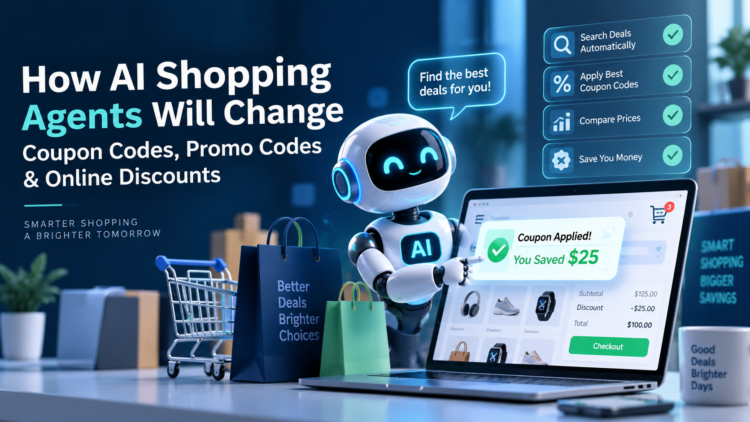
Online shopping is entering a new phase. For years, shoppers have searched for products, compared prices, looked for coupon codes, tested promo codes, and manually calculated whether a particular deal was actually worth buying.
That process could soon become much more automated.
AI shopping agents are emerging as a new layer between consumers, search engines, retailers, products, and checkout systems. Instead of simply showing search results, an AI agent can potentially help shoppers discover products, compare prices, find discounts, evaluate offers, and assist with purchasing decisions.
This creates an important question for the future of online discounts:
How will AI shopping agents change coupon codes, promo codes, and the way consumers find the best deals?
The answer may be bigger than simply making coupons easier to find. AI could transform coupon discovery into a broader process of shopping optimization, where the goal is not to find the biggest advertised discount, but to identify the best legitimate overall purchase price.
What Are AI Shopping Agents?
An AI shopping agent is an AI-powered system designed to help perform multiple steps of the shopping journey on behalf of a consumer.
Traditional online shopping often follows this process:
Search → Open Store → Find Product → Compare Prices → Search for Coupon → Apply Code → Checkout
An AI-assisted shopping experience could look more like:
User Intent → AI Shopping Agent → Product Discovery → Price Comparison → Coupon Discovery → Offer Verification → Total Cost → Purchase
This difference is important.
A traditional search engine primarily helps users find information. An AI shopping agent can potentially help users complete a shopping task.
For example, instead of searching:
“best running shoes under $100 coupon”
a shopper could potentially ask:
“Find the best running shoes under $100 and include any valid coupons, free-shipping offers, and cashback opportunities.”
The AI system can then interpret the broader shopping intent rather than focusing on one keyword.
This emerging model is closely connected with agentic commerce, where AI systems can assist with product discovery, comparison, and purchasing workflows.
How AI Shopping Agents Could Change Coupon Discovery
Today, finding a coupon code can require several separate searches.
A shopper may:
- Search for the store name.
- Search for available promo codes.
- Open several coupon websites.
- Check whether the code is expired.
- Read the coupon restrictions.
- Copy the code.
- Return to the retailer.
- Enter the code during checkout.
- Check whether the discount actually applies.
An AI shopping agent could potentially combine many of these steps.
The agent may search available information for:
- Coupon codes
- Promo codes
- Discount codes
- Store promotions
- Product-specific discounts
- New-customer offers
- Free-shipping offers
- Cashback opportunities
- Loyalty discounts
- Seasonal promotions
The important shift is that the AI does not necessarily need to ask:
“What coupon codes exist?”
It can instead ask:
“Which available offer produces the best valid outcome for this purchase?”
That is a much more sophisticated form of coupon discovery.
The Future of Coupons May Be About Total Savings
One of the biggest limitations of traditional coupon shopping is that the advertised discount does not always represent the shopper’s actual savings.
Consider three stores selling the same product.
| Store | Product Price | Coupon | Shipping | Final Cost |
|---|---|---|---|---|
| Store A | $100 | 20% off | $10 | $90 |
| Store B | $92 | None | $8 | $100 |
| Store C | $105 | 15% off | Free | $89.25 |
A shopper who only looks at the coupon percentage might immediately prefer Store A.
But Store C produces the lowest final price in this example.
This illustrates why future AI shopping agents may evaluate more than coupon percentages.
A more useful calculation is:
Product Price + Shipping + Fees − Coupon − Cashback = Effective Cost
This concept of effective price could become increasingly important as AI systems become more involved in online shopping.
Instead of simply finding a “20% off” coupon, an AI agent could potentially determine which combination of:
Price + Discount + Shipping + Cashback + Fees
results in the lowest legitimate total cost.
Coupon Codes Could Become Part of an Optimization System
The future of online discounts may therefore move from simple coupon searching toward discount optimization.
A shopping agent could potentially evaluate:
- Product price
- Current sale price
- Coupon code
- Promo code
- Shipping cost
- Taxes
- Service fees
- Cashback
- Loyalty discounts
- Membership pricing
- Payment promotions
- Bundle discounts
This means the value of a coupon may depend on what other offers are available.
For example, a 30% coupon is not necessarily better than a 15% coupon if the 15% offer can be combined with free shipping and cashback.
Therefore, the future question may not be:
“Which coupon has the highest discount?”
It may become:
“Which combination of available offers produces the lowest effective purchase cost?”
That is where AI-powered shopping could fundamentally change discount discovery.
Why Coupon Context Matters
A coupon code by itself contains very little information.
Consider:
SAVE20 — 20% OFF
That does not tell the shopper:
- When the code expires
- Whether a minimum purchase is required
- Which products qualify
- Whether sale products are excluded
- Whether the code is for new customers
- Whether it works in a particular country
- Whether it can be combined with another offer
For an AI retrieval system, this surrounding information is extremely valuable.
A useful coupon record can be understood through a semantic relationship such as:
Merchant → Coupon → Discount → Eligibility → Product Scope → Minimum Spend → Expiration → Restrictions → Verification
This creates much stronger semantic context than simply publishing a promotional code.
For example:
20% coupon for selected running shoes, valid for new customers, minimum order $75, excludes clearance items, expires on a specified date.
That information is far more useful for both shoppers and systems attempting to determine whether a particular offer is relevant.
Will AI Replace Coupon Websites?
AI shopping agents may change the role of coupon websites, but that does not necessarily mean coupon websites will disappear.
AI systems still need reliable information to retrieve.
An AI agent needs to know:
- Which coupon exists
- Whether it is current
- What products it applies to
- What restrictions exist
- Whether the offer is relevant
- How the discount affects the final price
This creates an opportunity for coupon and deal websites that provide accurate, structured, contextual, and regularly updated information.
A simple page containing hundreds of unexplained coupon strings may be less useful in an AI-driven shopping environment.
A page that clearly explains:
Offer → Eligibility → Restrictions → Expiration → Product Scope → Actual Savings
provides much richer information.
This is especially relevant to generative search and AI answer systems, where information may be retrieved and synthesized into a response rather than simply displayed as a traditional blue-link result.
Verified Offers Could Become More Valuable
One major challenge for AI shopping agents will be determining whether a discount is actually valid.
A promotional code might appear online but:
- Be expired
- Apply only to selected products
- Require a minimum order
- Be limited to first-time customers
- Exclude sale items
- Require a specific payment method
- Be restricted to a particular region
Therefore, future coupon discovery will likely need more than code availability.
It will require offer verification.
The semantic structure becomes:
Coupon → Eligibility → Conditions → Verification → Application → Final Price
This is particularly important because an AI shopping agent making a recommendation needs reliable information to avoid presenting an irrelevant or expired discount.
For SmartCartCode, this represents an important content opportunity: the value of a coupon page can extend beyond the code itself to the context and usefulness of the offer.
How AI Could Change Coupon Stacking
Another area where AI shopping agents could become useful is coupon stacking.
Shoppers may have access to several types of savings at the same time:
- Store sale
- Promo code
- Loyalty discount
- Cashback
- Credit-card promotion
- Free shipping
- New-customer discount
Manually determining which combinations work can be confusing.
An AI shopping agent could potentially evaluate the compatibility of these offers before checkout.
For example:
Original Price: $120
Sale Discount: −$20
Promo Code: −$15
Cashback: −$5
Shipping: $0
Effective Cost: $80
The important part is not the individual discount.
It is the combined outcome.
This could turn coupon stacking from a manual trial-and-error process into a more automated form of discount optimization.
AI Shopping Agents May Search for the Best Purchase, Not Just a Coupon
This may be the biggest long-term change.
Today, a shopper might ask:
“Does this store have a coupon?”
In the future, the shopper could ask an AI:
“Find me the cheapest legitimate way to buy this product.”
That request is much broader.
The AI could potentially compare:
Retailer Price
- Coupon
- Promo
- Shipping
- Cashback
- Membership Discount
- Payment Offer
- Return Conditions
The coupon then becomes just one variable within the overall purchase decision.
This creates a transition from coupon search to shopping intelligence.
Trust and Verification Will Become More Important
As shopping becomes more automated, trust becomes increasingly important.
An AI agent could theoretically recommend an expired coupon, misunderstand an eligibility condition, or calculate an incorrect final price.
That means shoppers need information they can understand and verify.
Useful discount information should clearly communicate:
Offer
What discount is being offered?
Eligibility
Who can use it?
Restrictions
What products, categories, or orders are excluded?
Expiration
When does the offer end?
Application
How should the shopper use it?
Final Savings
How much can the shopper realistically save?
This type of structured information provides stronger contextual relevance than simply displaying a coupon code.
What Does This Mean for the Future of Promo Codes?
Promo codes are unlikely to become irrelevant simply because AI shopping agents become more capable.
Instead, their role may change.
The traditional model is:
Merchant → Coupon → Consumer Search → Consumer Applies Code
The emerging model could become:
Merchant → Offer → AI Retrieval → Eligibility Check → Price Comparison → Discount Optimization → Consumer Authorization → Checkout
The shopper may eventually care less about the actual promotional code and more about the outcome.
Instead of asking:
“What is the coupon code?”
the shopper may simply ask:
“How much can I save?”
That could transform the coupon industry from simple coupon listings into broader discount intelligence.
What Should Shoppers Look for in an AI-Recommended Deal?
Even when an AI system recommends an offer, shoppers should consider several factors.
1. Verify the Offer
Make sure the coupon code or promo code actually applies to the intended purchase.
2. Check the Final Price
Do not judge a deal only by the percentage discount.
3. Include Shipping and Fees
A discount can be offset by shipping or additional checkout charges.
4. Check Restrictions
Look for minimum order requirements, product exclusions, and customer eligibility.
5. Consider Other Offers
A smaller coupon may produce greater savings when combined with another promotion.
6. Check the Source
Current, clearly documented, and contextual information is more useful than an unexplained discount claim.
The Future Shopping Journey
The traditional shopping process may increasingly evolve into an AI-assisted workflow:
User Intent
↓
AI Product Discovery
↓
Retailer Comparison
↓
Price Retrieval
↓
Coupon & Promo Discovery
↓
Offer Eligibility
↓
Shipping & Fee Calculation
↓
Review & Product Evaluation
↓
Total Cost Comparison
↓
Purchase Decision
↓
Checkout
This is the broader direction of agentic commerce.
Instead of simply retrieving a webpage, AI systems can increasingly combine information from multiple sources to help answer a shopping question or complete a task.
That means the future of online shopping may be less about manually searching through dozens of pages and more about expressing an intent and allowing intelligent systems to perform the research.
Frequently Asked Questions
How do AI shopping agents find coupon codes?
AI shopping agents can retrieve information from available online sources, merchant information, shopping platforms, and other connected data. Their exact capabilities depend on the AI system and the information sources available to it.
Can AI shopping agents automatically apply promo codes?
Some emerging shopping systems are designed to assist with parts of the checkout process. However, capabilities differ between platforms, and users may still need to authorize purchases or confirm transactions.
Will AI replace coupon websites?
AI may change how consumers discover discounts, but websites providing accurate, current, contextual, and verifiable coupon information can continue to serve as useful information sources for both shoppers and AI systems.
What will happen to coupon codes in the future?
Coupon codes are likely to remain part of online commerce, but their role may evolve. Instead of shoppers manually searching for individual codes, AI systems may increasingly discover, evaluate, and compare promotional offers as part of a broader shopping process.
Is the biggest discount always the best deal?
No. The largest advertised discount does not necessarily create the lowest final cost. Product price, shipping, fees, coupon restrictions, cashback, and other promotions can all affect the actual amount a shopper pays.
What is agentic commerce?
Agentic commerce refers to shopping experiences where AI agents help consumers discover, compare, evaluate, and potentially purchase products or services on their behalf.
Final Takeaway
The future of coupon codes, promo codes, and online discounts is not simply about finding more promotional codes.
It is about making better purchasing decisions.
AI shopping agents could connect product discovery, price comparison, coupon discovery, offer verification, shipping costs, reviews, cashback, and checkout into one continuous shopping workflow.
For shoppers, this could mean less time searching for discounts.
For retailers, it could create a new AI-driven route to customers.
And for coupon publishers, it could shift the focus from simply collecting codes toward creating accurate, contextual, verifiable, and retrieval-friendly discount information.
The central question of online discount discovery may therefore change from:
“Where can I find a coupon?”
to:
“What is the best legitimate way to complete this purchase?”
That shift could define the next generation of smart online shopping.
Leave Comment