
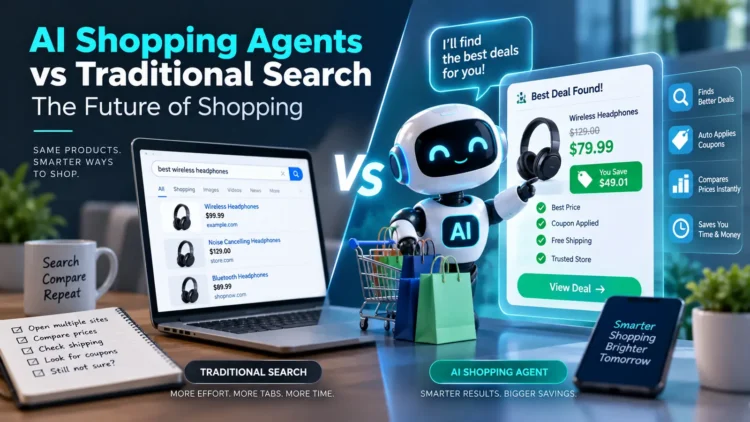
For decades, online shopping has followed a familiar process.
A shopper thinks about what they want, opens a search engine, types a query, reviews the results, visits different websites, compares products, checks reviews, searches for discounts, and finally decides what to buy.
That process is changing.
The emergence of AI shopping agents, AI search, conversational interfaces, and agentic commerce is creating a different way to discover and purchase products.
Instead of searching for ten different pieces of information, shoppers can increasingly describe what they want in natural language and expect an AI system to help connect the dots.
The difference can be summarized simply:
Traditional Search helps you find information.
AI shopping agents can help you complete a shopping task.
This does not mean traditional search is disappearing. Search engines remain an important discovery layer. Instead, online shopping is developing toward a more integrated system where search, retrieval, comparison, recommendation, discount discovery, and purchasing can work together.
For shoppers, this could mean less manual research.
For retailers and publishers, it could fundamentally change how products and information are discovered.
What Is Traditional Search?
Traditional search is primarily a query-and-results model.
A shopper enters a query such as:
“best wireless headphones under $100”
The search engine retrieves relevant webpages, product listings, reviews, shopping results, videos, and other information.
The shopper then does the next part of the work.
They may need to:
- Open product pages
- Compare specifications
- Read reviews
- Check prices
- Compare retailers
- Search for coupon codes
- Check shipping
- Investigate return policies
- Decide which product is best
The search engine helps with information retrieval, but the final research process is largely performed by the shopper.
The traditional journey can therefore be represented as:
Query → Search Results → Websites → Information → Manual Comparison → Purchase Decision
This model has worked extremely well for online discovery.
But it also creates a problem:
The more complex the shopping decision becomes, the more work the shopper has to do.
What Is an AI Shopping Agent?
An AI shopping agent is designed to go beyond returning a list of links.
Instead, it can potentially interpret the shopper’s broader intent and assist with multiple connected tasks.
For example, instead of asking:
“best laptop under $1,000”
a shopper could say:
“I need a laptop under $1,000 for video editing and travel. Prioritize battery life, low weight, good reviews, and current discounts.”
This request contains multiple requirements:
- Budget
- Product category
- Use case
- Performance
- Portability
- Reviews
- Discounts
An AI shopping system can potentially interpret these requirements as one shopping task.
The conceptual journey becomes:
User Intent → AI Retrieval → Product Discovery → Filtering → Comparison → Recommendation → Discount Discovery → Purchase Decision
That is fundamentally different from simply receiving ten search results.
AI Search vs Traditional Search
The distinction becomes clearer when comparing how each system handles a shopping question.
Traditional Search
A user searches:
“best running shoes for beginners”
The search engine may return:
- Articles
- Product pages
- Reviews
- Videos
- Retailers
- Shopping results
The user then reads and compares them.
AI Search
The user might ask:
“What are the best types of running shoes for a beginner who runs three times a week, and what should I look for before buying?”
An AI system can potentially synthesize information from multiple sources into a conversational answer.
The user can then continue:
“Which options are under $120?”
Then:
“Which one has the lowest total cost including shipping?”
Then:
“Are there any valid coupons?”
This creates a continuous conversational research journey.
The query is no longer a collection of isolated searches.
It becomes a context-aware shopping conversation.
AI Shopping Agents Can Understand Shopping Intent
One of the most important differences is intent interpretation.
Consider this search:
“black sneakers under $100”
A traditional search system primarily has to interpret the query and return relevant results.
An AI shopping agent can potentially understand that the shopper may care about:
Product Type + Color + Budget + Purchase Intent
The shopper could then add:
“I need them for daily walking.”
The context changes.
Then:
“I prefer lightweight shoes.”
The context becomes more specific.
Then:
“Show me options with free shipping.”
Now the shopping request includes another constraint.
The system can potentially maintain this context throughout the interaction.
This is one reason conversational product discovery could become increasingly important.
The Future Shopping Journey May Become Intent-Driven
Traditional shopping often begins with a keyword.
Future shopping may increasingly begin with intent.
Instead of:
“best phone 2026”
a consumer may say:
“I need a phone with excellent battery life, a strong camera, and enough performance for gaming. My budget is $500, and I want the lowest total price from a reputable retailer.”
That single request contains:
- Product requirements
- Performance requirements
- Budget
- Shopping intent
- Retailer preference
- Price optimization
The AI system can potentially turn that into multiple retrieval tasks.
This is where AI-powered product discovery becomes different from simple keyword search.
AI Shopping Agents and Product Comparison
Product comparison is another area where AI could reduce manual research.
Today, shoppers often create their own comparison.
For example:
| Factor | Product A | Product B | Product C |
|---|---|---|---|
| Price | $499 | $529 | $479 |
| Battery | 18 hrs | 14 hrs | 20 hrs |
| Weight | 3.2 lb | 2.9 lb | 3.5 lb |
| Rating | 4.5/5 | 4.6/5 | 4.3/5 |
| Warranty | 1 year | 2 years | 1 year |
The shopper must decide which combination of attributes matters most.
An AI shopping agent could potentially interpret the user’s priorities and explain the trade-offs.
For example:
“Because you prioritize battery life and lower weight, Product B may fit your requirements better despite its higher price.”
The important concept is not simply product comparison.
It is contextual product comparison.
The system compares products according to the shopper’s stated intent.
AI Could Change How Shoppers Find Coupons
This is where AI shopping agents connect directly with the future of coupon codes and promo codes.
Traditional shopping might require:
Product Search → Store Search → Coupon Search → Code Testing
An AI-assisted workflow could potentially become:
Product Discovery → Retailer Comparison → Coupon Discovery → Eligibility Check → Final Cost
Instead of asking:
“What coupon does this store have?”
the shopper could ask:
“Find the lowest total price for this product, including any valid coupons, free shipping, or cashback.”
The objective changes.
The shopper is no longer searching for a coupon.
They are searching for the best purchase outcome.
This creates a broader concept of AI-powered deal discovery.
Why the Lowest Product Price May Not Be the Best Deal
An AI shopping agent may need to consider more than the listed product price.
Imagine:
Retailer A
Product: $100
Coupon: $20 OFF
Shipping: $10
Total: $90
Retailer B
Product: $88
Coupon: None
Shipping: Free
Total: $88
Retailer A has the bigger coupon.
Retailer B has the lower final cost.
This is why future shopping systems may need to calculate:
Product Price + Shipping + Fees + Taxes − Discounts − Coupons − Cashback
The result is the effective cost.
This concept connects AI shopping with price intelligence, deal intelligence, and total-cost comparison.
AI Shopping Is More Than a Recommendation Engine
It is important to distinguish an AI recommendation from an AI shopping agent.
A recommendation system might say:
“You may also like Product B.”
An AI shopping agent could potentially handle a broader workflow:
Understand Intent → Search → Filter → Compare → Check Reviews → Check Price → Find Discounts → Evaluate Total Cost → Assist With Purchase
The second approach is closer to a task-oriented system.
That is why the concept of agentic commerce matters.
The AI is not simply recommending a product.
It is potentially participating in the shopping process.
The Role of Retrieval in AI Shopping
Behind an AI shopping experience is a crucial process:
Retrieval.
An AI system needs access to relevant information before it can provide a useful answer.
For a shopping query, relevant information could include:
- Product specifications
- Current prices
- Retailer information
- Reviews
- Shipping information
- Return policies
- Coupon codes
- Promo codes
- Discounts
- Product availability
- Warranty information
The system then needs to connect these pieces of information to the user’s intent.
This creates a semantic chain:
User Query → Intent → Retrieval → Product Information → Comparison → Recommendation
For content publishers, this has an important implication.
Creating content around isolated keywords may be less useful than building comprehensive coverage around the entities and relationships surrounding a topic.
For example, a page about a laptop should not only mention:
“best laptop.”
It can also cover:
Price → Specifications → Battery → Reviews → Warranty → Shipping → Discounts → Coupons → Seller → Returns
That creates a much stronger semantic context.
Why Semantic Context Matters
Imagine two pages.
Page A
“Laptop coupon code. Get 20% off laptops.”
Page B
“This laptop is currently listed at $799. A promotional discount may reduce the purchase price, while shipping, taxes, product eligibility, warranty, and return conditions should be considered when comparing the final cost.”
Page B contains a much richer network of concepts.
It connects:
Laptop → Price → Discount → Promotion → Shipping → Taxes → Warranty → Returns → Comparison
For AI retrieval and generative systems, this type of contextual information can be more useful because the concepts are connected rather than isolated.
This is also why SmartCartCode articles should be written as topical knowledge resources, not simply as keyword-targeted pages.
Traditional Search Still Matters
The rise of AI shopping does not mean traditional search becomes irrelevant.
Search engines remain a major gateway to:
- Product information
- Retailers
- Reviews
- Deals
- Coupons
- Shopping guides
- Brand information
In fact, AI systems themselves depend heavily on information retrieval.
The difference is increasingly about the interface between the user and the information.
Traditional search often asks:
“Which pages should I show you?”
AI-assisted search increasingly asks:
“Which information do you need to accomplish your task?”
Both models can coexist.
A shopper may discover a product through traditional search, investigate it using AI, visit a retailer, and use a coupon website before completing the purchase.
The future may therefore be a hybrid search ecosystem, not a complete replacement of one system by another.
How AI Could Change Product Reviews
Product reviews may also become more contextual.
Instead of reading 100 reviews manually, a shopper could potentially ask:
“What are the most common complaints about this product from long-term users?”
or:
“Which reviews mention battery degradation?”
or:
“Does this product perform well for travel?”
The AI system can potentially retrieve relevant review information and organize it around the shopper’s question.
This means review content, product specifications, user experiences, and buying guides can become part of the same retrieval ecosystem.
For publishers, this increases the importance of providing specific, useful, and clearly structured information.
AI Shopping Agents and Personalized Recommendations
Traditional recommendations often rely on general signals such as:
- Popularity
- Ratings
- Similar products
- Purchase history
AI shopping agents could potentially incorporate explicit user preferences into the conversation.
For example:
Budget: $150
Use: Travel
Priority: Battery life
Preference: Lightweight
Requirement: Free shipping
The resulting recommendation can be based on the user’s stated priorities rather than popularity alone.
This creates a shift from:
“What products are popular?”
toward:
“What product fits this particular shopping intent?”
That is a significant development for personalized product discovery.
What Happens to Shopping Websites?
The growth of AI-assisted shopping could also change how websites are discovered.
If users increasingly ask AI systems for product recommendations, retailers and publishers may need their information to be:
- Clear
- Structured
- Current
- Factual
- Context-rich
- Easy for search and AI systems to retrieve
This does not mean writing specifically for machines.
It means creating content that clearly communicates:
Who → What → Why → Price → Conditions → Evidence → Context
For SmartCartCode, this is particularly relevant.
A coupon page should explain the offer.
A shopping guide should explain the decision.
A deal article should explain the savings.
A product comparison should explain the trade-offs.
The goal is to create information that remains useful whether the user reads it directly or encounters it through an AI-generated answer.
The Future of Online Shopping
The shopping journey could increasingly evolve from:
Search → Browse → Compare → Decide → Buy
to:
Intent → AI Retrieval → Discovery → Comparison → Optimization → Decision → Purchase
The difference is subtle but powerful.
The consumer may provide the objective.
The AI system can potentially perform more of the research.
For example:
“Find me a reliable laptop for travel under $1,000, compare the best options, check reviews, include current discounts, and show me the lowest total price.”
That is no longer a simple search query.
It is a shopping task.
And shopping agents are being designed around exactly this kind of task-oriented interaction.
What Should Shoppers Still Verify?
Even with increasingly intelligent AI shopping systems, shoppers should not assume every recommendation is automatically correct.
Before purchasing, verify:
Product
Is it the exact model, size, version, and condition you want?
Price
Is the price current?
Discount
Does the coupon code or promo code actually apply?
Shipping
Is shipping included in the quoted price?
Seller
Who is actually selling the product?
Reviews
Are the reviews relevant to the exact product?
Returns
What happens if you need to return it?
Warranty
What protection is included?
Final Cost
What will you actually pay at checkout?
These checks remain important because an AI-generated recommendation is only as useful as the information it retrieves and the context in which it interprets that information.
Frequently Asked Questions
What is the difference between AI shopping agents and traditional search?
Traditional search primarily returns information and links based on a query. AI shopping agents are designed to understand broader shopping intent and potentially perform multiple connected tasks such as product discovery, comparison, discount discovery, and purchase assistance.
Will AI shopping agents replace Google Search?
Not necessarily. Traditional search and AI search can coexist. Search engines remain important information and discovery systems, while AI interfaces can provide a more conversational and task-oriented way to interact with retrieved information.
How do AI shopping agents compare products?
An AI shopping agent can potentially compare factors such as price, specifications, reviews, shipping, discounts, warranty, and return policies according to the shopper’s requirements.
Can AI shopping agents find coupon codes?
AI systems can potentially retrieve coupon codes, promo codes, discounts, and promotional offers from available information sources. The important challenge is determining whether an offer is current, relevant, and actually applicable.
What is agentic commerce?
Agentic commerce describes shopping experiences in which AI agents assist with or potentially perform parts of the commerce journey, including product discovery, comparison, recommendation, and purchasing.
What is AI product discovery?
AI product discovery is the use of AI systems to help users find products based on natural-language requirements, preferences, budget, use case, and other contextual information.
Is AI shopping better than traditional search?
The two approaches serve different purposes. Traditional search provides broad access to webpages and information, while AI shopping interfaces can provide a more conversational and task-oriented experience. Which approach is more useful depends on the shopper’s specific task.
How will AI change online shopping?
AI could connect search, product discovery, price comparison, reviews, coupon discovery, recommendations, and checkout into a more integrated shopping workflow.
Final Takeaway
The biggest change AI could bring to online shopping is not simply better search.
It is the transition from searching for information to delegating a shopping task.
Traditional search gives shoppers access to information.
AI search can organize information conversationally.
AI shopping agents can potentially connect that information into a broader workflow.
The emerging shopping journey can be represented as:
User Intent
↓
AI Search & Retrieval
↓
Product Discovery
↓
Product Comparison
↓
Price & Deal Intelligence
↓
Coupon & Promo Discovery
↓
Total Cost Calculation
↓
Recommendation
↓
Purchase
For shoppers, this could mean less manual research.
For retailers, it could create new ways for products to be discovered.
For publishers such as SmartCartCode, it makes clear, structured, accurate, contextual, and semantically rich content increasingly important.
The future of shopping may therefore not be about choosing between search and AI.
It may be about how effectively search, retrieval, AI reasoning, product data, discounts, and commerce work together to help consumers make informed purchasing decisions.
Leave Comment