
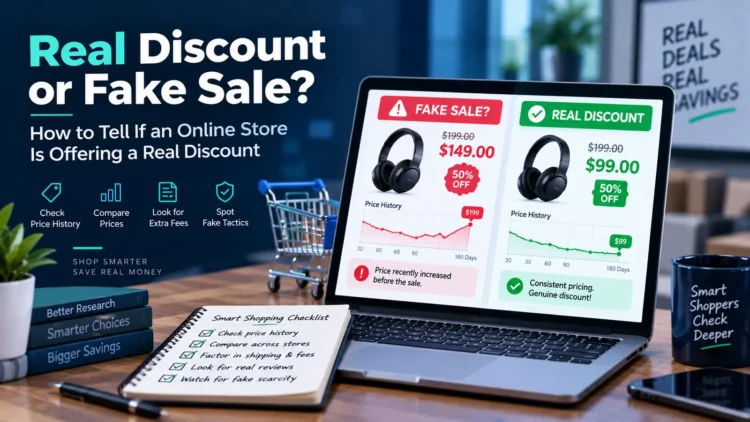
A bright red “50% OFF” badge can make almost any product look like a bargain.
But there is a simple question shoppers should ask before trusting the discount:
50% off compared with what?
That question is at the heart of real discount verification.
An online store may show an original price, a crossed-out price, a percentage reduction, or a limited-time sale message. But the size of the displayed discount does not automatically tell you how much money you are actually saving.
The important comparison is between the current selling price and a meaningful reference price.
For example, if a product is displayed as:
Was $200 → Now $100 → 50% OFF
it looks like an exceptional deal.
But what if the product was selling for $105 shortly before the sale?
In that situation, the “50% OFF” message tells only part of the story.
This is why price history, reference pricing, historical prices, competitor prices, coupon codes, shipping costs, and final checkout prices can all matter when evaluating an online deal.
The goal is not to assume that every sale is fake.
The goal is to determine whether the advertised discount represents genuine savings.
What Is a Fake Discount?
A fake discount is a discount claim that gives shoppers a misleading impression about the amount they are saving.
This can happen when the comparison price is:
- Inflated
- Rarely used
- Not a meaningful market price
- Based on an unclear reference
- Temporarily increased before a “sale”
- Presented without enough context
A discount can also appear attractive while the final purchase remains expensive because of:
- Shipping
- Mandatory fees
- Taxes
- Product exclusions
- Minimum-order requirements
- Membership conditions
- Other restrictions
The important distinction is:
A large advertised discount does not automatically equal a large real-world saving.
The Basic Anatomy of an Online Discount
A typical sale can be understood as:
| Price Element | Example |
|---|---|
| Reference / Original Price | $200 |
| Advertised Sale Price | $120 |
| Advertised Discount | 40% |
| Shipping | $10 |
| Coupon | −$5 |
| Final Pre-Tax Cost | $125 |
But the real question remains:
Was $200 actually a meaningful reference price?
If the product was normally sold for around $125–$130, then the advertised 40% discount can create a very different impression from the product’s actual market pricing.
That is why reference price verification matters.
What Is a Reference Price?
A reference price is the price used as the comparison point when a retailer presents a discount.
It might be described as:
- Original Price
- Regular Price
- List Price
- MSRP
- Was Price
- Previous Price
- Compare-at Price
- Recommended Retail Price
These terms are not necessarily interchangeable.
The important question is:
Does the reference price represent a meaningful price against which the current offer can reasonably be evaluated?
A shopper should therefore avoid automatically assuming:
Original Price = Normal Market Price
Those two numbers can be different.
Why Price History Is One of the Best Ways to Check a Discount
One of the strongest ways to evaluate a sale is to look at the product’s price history.
Instead of asking:
“How much discount does the store claim?”
ask:
“What did this product actually sell for recently?”
Imagine this price history:
| Period | Product Price |
|---|---|
| 60 days ago | $119 |
| 45 days ago | $115 |
| 30 days ago | $110 |
| 15 days ago | $112 |
| Today | $105 |
Now imagine the store displays:
Was $150 → Now $105 → 30% OFF
The $105 price may still be a reasonable price.
But the $150 reference price does not tell the shopper what the product actually sold for recently.
The historical context provides a much clearer picture.
The 30-Day Price History Concept
For shoppers in the European Union, there is a particularly useful reference point.
Under EU consumer rules on price reductions, when a trader announces a price reduction, the reference price generally has to be the lowest price applied during at least the previous 30 days, subject to certain exceptions and national implementation details. The European Commission has also reported recent enforcement checks finding incorrect discount references in online sales.
The purpose is straightforward:
A retailer should not be able to temporarily increase a price and then present the reduced price as a dramatic discount against that artificially elevated price.
The European Commission’s 2026 sweep of 314 online traders found that 30% referenced discounts incorrectly, while many other traders had unclear price-comparison information.
This does not mean every country follows the same rule.
Consumer-protection and pricing requirements vary by jurisdiction.
But the underlying shopping principle is broadly useful:
Check the recent price before trusting the size of the discount.
How to Check If a Sale Price Is Real
Use this compact verification process before deciding that a product is genuinely discounted.
| Step | What to Check |
|---|---|
| 1. Identify | Exact product, model, size and condition |
| 2. Record | Current selling price |
| 3. Verify | Historical price |
| 4. Compare | Other retailers |
| 5. Check | Reference / original price |
| 6. Review | Coupon and promotion conditions |
| 7. Add | Shipping, taxes and mandatory fees |
| 8. Calculate | Real effective cost |
| 9. Evaluate | Actual savings |
This turns a marketing claim into a measurable comparison.
Compare the Current Price With the Market, Not Just the Store’s Reference Price
Another important technique is competitor price comparison.
Suppose a retailer shows:
Store A
$250 → $150
50% OFF
That sounds impressive.
But suppose:
| Retailer | Current Price | Shipping | Total |
|---|---|---|---|
| Store A | $150 | $15 | $165 |
| Store B | $145 | Free | $145 |
| Store C | $139 | $8 | $147 |
Suddenly, the “50% OFF” offer is no longer the most important piece of information.
Store C may have the lowest purchase cost.
This demonstrates why real discount analysis should consider both:
Historical Price
and
Current Market Price
A store’s own reference price is only one part of the picture.
Why the Lowest Price and the Biggest Discount Are Different
There are three different concepts shoppers often confuse:
Advertised Discount
The percentage shown by the retailer.
Actual Savings
The difference between a meaningful reference price and the current price.
Best Deal
The overall value after considering price, shipping, coupons, fees, product quality, and other factors.
These can produce different results.
Example
Product A
- Reference price: $200
- Sale price: $120
- Advertised discount: 40%
Product B
- Reference price: $150
- Sale price: $105
- Advertised discount: 30%
Product A has the larger percentage discount.
Product B costs less.
But even that is not enough.
You still need to ask whether the reference prices are meaningful and whether shipping, coupons, taxes, or other costs change the final result.
Watch for “Was” Prices That Lack Context
One common source of confusion is the “was/now” pricing format.
For example:
$300$179
The shopper immediately sees a $121 difference.
But what does the $300 represent?
It could be:
- A manufacturer’s suggested retail price
- A previous selling price
- A list price
- A temporary price
- A comparison price
- Another reference selected by the retailer
The important question is not simply:
“Is $300 a real number?”
The better question is:
“Was $300 a meaningful price for this product in the relevant market and period?”
That is where price history becomes powerful.
Check for Temporary Price Increases
A particularly important pattern to watch is:
Normal Price → Price Increase → “Sale” → Reduced Price
For example:
| Time | Price |
|---|---|
| Week 1 | $100 |
| Week 2 | $100 |
| Week 3 | $130 |
| Week 4 | $100 |
| “SALE” | 23% OFF |
The product is technically being sold at a lower price than the immediately preceding $130 price.
But the shopper should also know that the product was previously available for $100.
This is why historical pricing provides context that a single price snapshot cannot.
EU guidance on price reductions specifically discusses the risk of manipulating reference prices and uses the previous 30-day lowest price as a safeguard in its framework.
“Limited-Time” Does Not Automatically Mean Better
Another powerful psychological signal is urgency.
You may see:
- Limited Time
- Today Only
- Ends Tonight
- Final Hours
- Flash Sale
- Last Chance
- Only 2 Hours Left
These messages can encourage faster purchasing decisions.
But urgency does not prove that the underlying price is exceptional.
A useful rule is:
Urgency tells you when an offer may end. Price history tells you whether the offer is actually unusual.
Those are two different pieces of information.
Be Careful With “Up to 70% Off”
Another common promotional phrase is:
“Up to 70% OFF”
This does not mean every product is 70% cheaper.
It means that at least some qualifying products may receive a discount as high as 70%.
The majority of products may have smaller discounts.
For example:
| Product | Discount |
|---|---|
| Product A | 70% OFF |
| Product B | 40% OFF |
| Product C | 25% OFF |
| Product D | 15% OFF |
| Product E | 10% OFF |
Therefore, shoppers should always check the exact product rather than relying on the headline percentage.
“From $29” Can Also Be Misleading
The same principle applies to:
“Products from $29”
This means some qualifying product may start at $29.
It does not mean the product you want costs $29.
Always move from the general promotional claim to the specific product price.
Check Whether the Product Has Been on Sale Repeatedly
A product that is “on sale” almost every week raises another question:
Is the sale price actually the normal price?
Consider:
| Week | Displayed Price |
|---|---|
| Week 1 | $99 Sale |
| Week 2 | $99 Sale |
| Week 3 | $99 Sale |
| Week 4 | $99 Sale |
| Week 5 | $99 Sale |
If the product spends most of its time at $99, then treating $149 as the meaningful reference point may give shoppers an exaggerated impression of savings.
The label “SALE” does not itself establish how unusual the price is.
Look Beyond the Discount to the Final Price
A discount can be genuine and still not produce the best deal.
For example:
Store A
- Product: $100
- 20% coupon: −$20
- Shipping: $15
- Final: $95
Store B
- Product: $92
- No coupon
- Free shipping
- Final: $92
Store A has the coupon.
Store B has the lower final cost.
This is why discount verification and total-cost comparison should work together.
The complete shopping calculation is:
| Component | Effect |
|---|---|
| Product Price | Starting point |
| Sale Discount | Reduces cost |
| Coupon Code | May reduce cost |
| Shipping | May increase cost |
| Taxes | May increase cost |
| Mandatory Fees | May increase cost |
| Cashback | May reduce effective cost |
| Final Price | Actual checkout amount |
| Effective Cost | Broader economic comparison |
The FTC advises online shoppers to check the terms of advertised deals, consider total costs, and account for shipping and other add-ons when comparing online prices.
Dynamic Pricing Adds Another Layer
Modern ecommerce can also involve dynamic pricing, where prices change based on factors such as demand, inventory, location, timing, or other business conditions.
The existence of dynamic pricing does not automatically mean a price is deceptive.
The important issue is whether pricing information is presented accurately and transparently.
The FTC’s current guidance on unfair or deceptive fees notes that businesses may use dynamic pricing, provided pricing information is not misleading.
For shoppers, this creates another reason to treat a single screenshot or single price as incomplete evidence.
A more reliable approach is:
Price Snapshot + Price History + Market Comparison + Final Cost
Personalized Pricing Could Make Price Comparison More Complex
Another emerging issue is personalized pricing.
Personalized pricing refers to situations where businesses may use information about an individual consumer to determine or tailor a price based on an estimate of what that person may be willing to pay.
The FTC opened a public-comment process in August 2026 concerning a proposed enforcement policy statement on personalized pricing and noted concerns about consumers receiving prices influenced by personal data.
This is an evolving area, and rules vary by jurisdiction.
For consumers, the broader lesson is that price transparency and comparison may become increasingly important as ecommerce pricing systems become more sophisticated.
How AI Can Help Detect Better Deals
This is where the future of AI shopping becomes interesting.
An AI shopping agent could potentially evaluate multiple pricing signals instead of looking only at the current sale label.
Conceptually:
| AI Shopping Signal | Question |
|---|---|
| Current Price | What does it cost now? |
| Price History | What did it cost recently? |
| Reference Price | What is the comparison price? |
| Competitor Price | What are other retailers charging? |
| Coupon | Is there a valid discount code? |
| Shipping | What is the delivered cost? |
| Reviews | Is the product worth buying? |
| Return Policy | What happens if it doesn’t work out? |
The future of deal intelligence may therefore move from:
“Find a sale.”
to:
“Determine whether this sale represents genuine value.”
That is a much more sophisticated shopping problem.
The Future of Discount Verification
As AI shopping agents become more common, price history and discount context could become increasingly important.
A shopping agent does not just need to know:
“This product is 40% OFF.”
It needs to understand:
40% OFF compared with what?
A richer shopping-data structure could look like:
Discount Verification Flow
| Stage | Information |
|---|---|
| Product | Exact product identity |
| Current Price | Today’s selling price |
| Reference Price | Price used for comparison |
| Historical Price | Recent actual prices |
| Market Price | Comparable retailer prices |
| Promotion | Current sale or campaign |
| Coupon | Additional applicable discount |
| Shipping | Delivered cost |
| Final Price | Checkout amount |
| Savings | Realistic monetary difference |
This creates a stronger semantic context for both shoppers and systems that retrieve shopping information.
A Simple “Is This Really a Deal?” Checklist
Before trusting an online sale, ask these questions:
Product
- Am I looking at the exact product?
- Is it new, refurbished, used, or open-box?
- Is the model or version identical?
Price
- What is the current price?
- What was the price recently?
- What is the competitor price?
Discount
- What is the reference price?
- Is the advertised percentage based on a meaningful comparison?
- Is this product actually included?
Coupon
- Is there a valid coupon code?
- Are there minimum-spend requirements?
- Are there product exclusions?
Cost
- What is shipping?
- Are there taxes?
- Are there mandatory fees?
- What is the final checkout amount?
Value
- Are the reviews reliable?
- Is the seller trustworthy?
- What is the return policy?
- Is there a warranty?
Final Question
Would I still consider this a good deal if the “50% OFF” label disappeared?
If the answer is yes because the current price is genuinely competitive, that is a much stronger signal of value.
A Practical Real-Deal Formula
For everyday shopping, use this framework:
| Calculation | Purpose |
|---|---|
| Current Price | What you pay for the product |
| − Valid Discount | Sale or promotional savings |
| − Coupon | Additional applicable savings |
| + Shipping | Delivery cost |
| + Mandatory Fees | Additional unavoidable charges |
| + Taxes | Applicable taxes |
| − Cashback | Potential effective savings |
| = Effective Cost | Better comparison number |
Then compare the effective cost against:
Recent Price History + Competitor Prices + Product Value
This gives you a much more complete picture than a large red discount badge.
Frequently Asked Questions
How can I tell if an online discount is real?
Check the product’s recent price history, compare it with prices at other retailers, verify the reference price, and calculate the final cost after shipping, fees, taxes, and applicable coupons.
What is a fake discount?
A fake discount generally refers to a promotional presentation that gives a misleading impression about the amount or value of a price reduction. One common concern is using an inflated or poorly grounded reference price to make a current price appear more discounted than it really is.
How does price history help identify fake sales?
Price history shows what a product actually sold for over time. It can reveal whether today’s “sale” price is genuinely unusual or close to the product’s normal recent selling price.
What is a reference price?
A reference price is the price used as the comparison point for a discount, such as an original price, regular price, list price, or previous price. Its usefulness depends on whether it represents a meaningful comparison.
Is a 50% discount always a good deal?
No. A 50% discount may look attractive, but the reference price may not represent a meaningful market price. The final purchase cost and recent price history provide better context.
What does “up to 70% off” mean?
“Up to 70% off” means some qualifying products may have discounts as high as 70%. It does not mean every product in the sale is discounted by 70%.
Should I compare prices across different stores?
Yes. Competitor price comparison can help determine whether a sale price is actually competitive in the broader market.
Can AI detect fake discounts?
AI shopping systems could potentially compare current prices, historical prices, competitor prices, discounts, coupons, and final costs to help evaluate whether an offer represents meaningful value. However, the accuracy of any AI assessment depends on the quality, freshness, and completeness of the information it can access.
Final Takeaway
A large “50% OFF” label is not proof that you are getting a 50% saving compared with a meaningful market price.
The smarter approach is to investigate the context behind the discount.
Don’t ask only “How much is it discounted?” Ask “Discounted from what, compared with what, and what will I actually pay?”
A reliable online deal verification process combines:
Price History + Reference Price + Competitor Price + Coupon + Shipping + Fees + Final Cost
When these pieces are considered together, shoppers can move beyond marketing claims and evaluate the real value of an online deal.
As ecommerce becomes increasingly data-driven and AI shopping agents become more capable, this type of price intelligence may become an important part of how consumers discover and evaluate products.
The future of smart shopping is not simply about finding the biggest percentage discount.
It is about knowing whether the discount is real, relevant, competitive, and valuable.
Leave Comment